#ZimIndustry Insights
Click cover to download
Good Intentions in a Changing World
In Zimbabwe’s industrial policy architecture lies a tension that is not unique to this economy, but to every country attempting to industrialise under changing global conditions, whether to preserve the status quo under pressure from international integration and competition, or redesign an industrial ecosystem capable of surviving modern markets.
The manufacturer didn’t see the ambush coming.
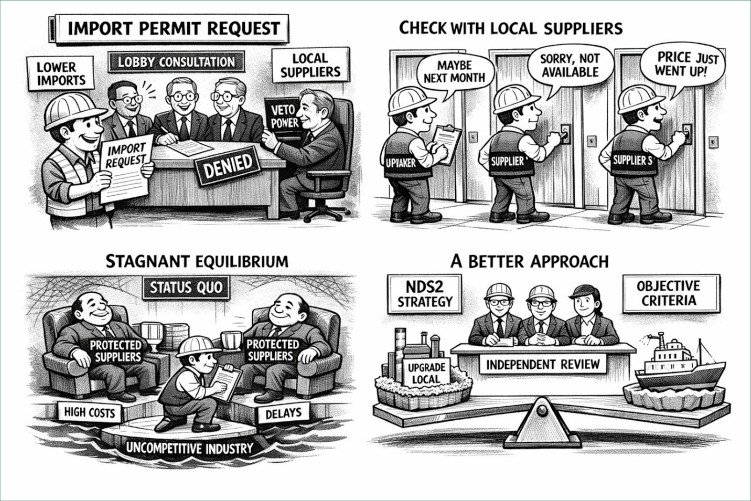
He had done everything right. Built his operation carefully. Found a regional supplier offering better raw materials at lower cost, the kind of input upgrade that could finally make his products competitive on export markets. He filed the paperwork. He waited. He made his case through proper channels.
Under the import-permit system applied to selected goods and industrial raw materials, an uptaker’s application automatically activates consultation with associations representing domestic suppliers, effectively granting those protected by policy a voice over the purchasing decisions of those expected to compete downstream. Framed in the language of import substitution or infant-industry protection, concepts historically used by Britain and the United States during their own ascent, the process often concludes with regulators deeming local capacity “adequate,” yet adequacy is measured largely in supply presence rather than capability, consistency or competitiveness.
The structural consequence is subtle but significant with suppliers gaining insulation from upgrading pressure while uptakers absorb higher costs and quality constraints, turning protection from a bridge toward industrial learning into a mechanism that preserves existing positions and slows the very competitiveness industrial policy seeks to create.
Industrial policy rarely fails through intent. It fails through structure.
The real problem is not protection or liberalisation. It is the inability of policy systems to distinguish between protection that builds capability and protection that preserves rent. There remains a persistent belief that new industry will somehow emerge organically from the veins of the old. History suggests otherwise. Industrial transformation is rarely evolutionary but usually the product of deliberate restructuring under disciplined pressure.
Two Truths, One Knife’s Edge
Zimbabwe’s industrial policy operates on a knife’s edge between two legitimate fears.
The first fear is exposure, opening domestic industries to foreign competition before they are ready, triggering a wave of factory closures. This is the very scenario Chang warns about when developed nations “kick away the ladder,” forcing free trade on countries that haven’t yet built the industrial muscle to survive it causing deindustrialisation that could take a generation to reverse.
The second fear is insulation, the point where protection ceases to produce learning and instead delays adaptation. Steve Coulter argues that successful industrial policy requires disciplined dialogue between state and industry to identify binding constraints rather than sustain permanent rents. The difference between these outcomes is not policy itself. It is whether protection changes firm behaviour.
When the ladder becomes a barricade rather than a climbing tool, industrial policy begins to work against its own objectives.
The Art of the Strategic Shield
Protectionism has never been inherently flawed. At its best, it is one of the most powerful instruments of industrial transformation.
South Korea shielded firms, but under conditions that enforced export performance and productivity growth. Protection was temporary, competition was postponed, not removed. China imposed technology transfer and joint venture requirements in key strategic sectors, using access to its domestic market as leverage to accelerate capability formation. Ethiopia experimented with special economic zones, with uneven results, attempting to create controlled environments where manufacturing capacity could develop under managed exposure to global markets.
The common principle was not protection itself, but discipline.
Protection succeeded when it accelerated learning faster than it delayed competition. Where this logic was abandoned, support became indefinite, and industries learned to lobby rather than improve.
There is a school of thought that Zimbabwe’s protection, too often, has been none of these things. It has been indefinite. Unconditional. And quietly captured by the very industries it was supposed to be transforming.
The Gauntlet
The “Infant Industry and import substitution” argument are very powerful tools in the lobbyist’s kit. History shows it works, for instance, Britain used it for centuries to nurture its wool industry during the first and second industrial revolution before preaching free trade to the world. However, as Coulter points out, the risk in modern developing states is “market failure” being replaced by “policy or regulatory failure”.
When regulators assess local capacity, they often measure output volume rather than capability transmission like the technological spillovers, productivity improvements, and linkages that justify intervention in the first place. A supplier that delivers sub-standard inputs, inconsistent quantities or poor reliability is not an infant progressing toward maturity. Their preservation becomes a constraint on every downstream producer.
The Cost of Avoiding Choice
Agro-processors, light manufacturers, and renewable energy component makers represent sectors with real opportunity but also deep structural constraints, such as technology gaps, infrastructure deficits, and fragmented supply chains.
Open markets immediately and many collapse.
Keep markets closed indefinitely and they stagnate.
The uncomfortable truth is that transformation requires selective restructuring. Some lines will disappear. Some firms will consolidate. Others will invest and scale. China could internalise full value chains because scale offered strategic freedom. Smaller economies do not possess that luxury. They must instead choose strategic nodes within regional or global value chains and deepen capability there.
The AfCFTA transition is accelerating these decisions. Standards are tightening. Markets are integrating. Each quarter spent delaying adjustment raises the eventual cost of transition. Where industrial adaptation stalls, the consequences do not remain confined to factories, they emerge as slower productivity growth, weaker export competitiveness, and rising foreign exchange pressure.
Industrial policy ultimately shows up in macroeconomic outcomes.
Six Disciplines for Zimbabwe’s Industrial Transition
Zimbabwe’s challenge is not the absence of policy tools, but the absence of structured discipline in their application.
- Sunset clauses on protective instruments, ensuring support remains transitional rather than permanent. The dairy industry benefited from government policy of encouraging companies to reduce their reliance on powdered milk imports through a dairy revitalisation levy and import quotas that were revised downwards annually. The proliferation of companies that have invested in higher value-added activities resulting in regionally competitive and differentiated products is testament to such an approach.
- Performance milestones tied to measurable competitiveness outcomes.
- Dual-sourcing rights allowing downstream manufacturers access to competitive inputs when local supply fails to meet standards.
- Upgrading funds such as the industrial development fund announced last year directed toward technology acquisition, certification and skills development — capability rather than cushioning.
- Pathways for informal sector integration that preserve competitiveness while expanding productivity.
- Strategic AfCFTA sequencing, using available flexibilities to liberalise deliberately while safeguarding developmental priorities.
These are not recommendations so much as conditions for avoiding the historical cycle of protection followed by stagnation.

Kevin Msipha
Value Chains & Sectors Coordinator
Author